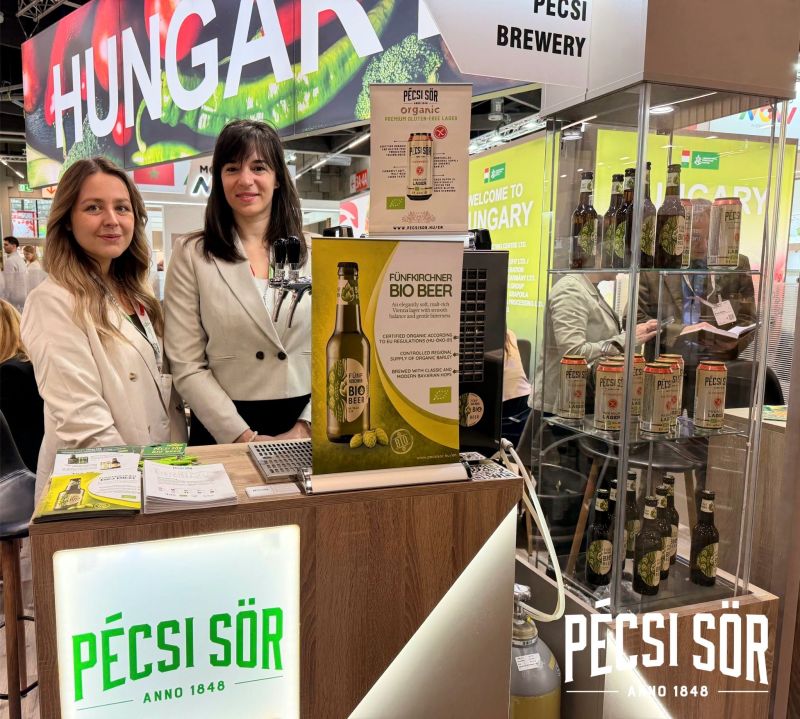
On October 21, at the suggestion of Diána Elmer, the Szentágothai Vocational College revived an old tradition and invited its members to a beer tasting organized by our fellow vocational college member Nóra Mits, whom we would like to thank for her work. In the Pécsi Szalon Brewery, which was redesigned in the spring at 16 Széchenyi tér, the owner and managing director of the Pécsi Brewery, Zoltán Szemerey, guided us through the intricate world of beer production, distribution and consumption.
Our extensive tasting at Beertok Bar in the fall of 2017 was followed by a more intensive one this time. Back then, we were introduced to the flavors of seven beers from five countries, and this time, the main focus was specifically on Pécs beers. Although our previous tasting was far removed from this one, the enthusiastic members of the professional college maintained a close connection with the brewing tradition during that time, from touring the Pécs Brewery to attempting to brew their own beer. And of course, the number of people interested in beer culture has also grown over the years, and twenty-one of us finally gathered at the Wednesday evening event.
The secret of the Pécsi Brewery's rise is perhaps that, with its rather medium-sized size, it can now confidently focus on expanding its range. In recent years, its annual production of no more than two hundred thousand hectoliters has allowed it to launch new premium-category beers, with its products holding a stable market share of around three percent. While sipping our first light Pécsi Beer, we started to learn about brewing from the basics. We talked about the most basic condition for beer production, water, which is available in Pécs, but as we learned, the good-quality but hard drinking water found here is not the best suited for beer production, so it is first softened using a reverse osmosis process.
Our second drink was the Szalon Light bottom-fermented, filtered lager type beer, as the brewery, as the oldest brewery in Hungary, places great emphasis on its traditions, and Szalon is the name of the earliest Hungarian beer. After the two filtered light beers, we were served a rich selection of snacks so that we could paddle into more exciting waters.
Since top-fermented beers have been experiencing a renaissance in recent years, the unfiltered Pécsi Craft APA could not be left out of the lineup, which swept many of us off our feet with its characteristic bitterness and refreshing citrusy, fruity aromas. While tasting it, we gathered valuable knowledge about the history, conditions, and cold hopping of bottom-fermented lager and top-fermented ale-type beers.
After that, while drinking a Pécsi Premium Wheat, the discourse was about the growing demand for more specialized beers. The pioneering activities and experimental spirit of smaller craft/craft producers must be mentioned here. Of course, later on, on the beaten track, in response to the already emerging market demand, larger companies also start optimizing certain beer specialties, but due to their size, profit orientation and prestige, they are less inclined to experiment blindly. We can deviate from this to the topic of the ethics of beer production and consumer responsibility, since the production and optimization of a successful craft beer-like beverage dreamed up in a small-scale environment in some cases means the grinding out of small beer's raw capital. On the other hand, we can think of craft producers as those who dare to put their visions into practice, and by creating market demand, they willy-nilly put pressure on corporate monsters to innovate. In this regard, the Pécsi Brewery is a true middle-of-the-road, reimagining the brewery, striving for both premium quality and innovation.
Tasting the Pécsi Premium Brown served us with a useful lesson in terms of our later consumer decisions. With marginally popular beers, it can happen that they don't sell out quickly enough and therefore stay on tap for too long. In order to observe this phenomenon, we tasted a draft and a bottled version of the brewery's brown beer in parallel. The draft brown noticeably lost its coffee and cocoa aroma compared to the bottled one, so the lesson is that if we choose from the tap, we should try to ask for the more popular beers. We also talked about the fact that canned beers are least affected by light-induced quality deterioration, so it's best to take this into account in stores.
The topic of sustainability has also come to the fore in relation to packaging, and within a few years we can expect deposit fees similar to the German system for cans, which are high enough to make it worthwhile for consumers to actually return their packaging. The fate of by-products produced during beer production has also been raised. Beer lees contain extremely valuable vitamins and minerals, and the issue of marketing them in the form of dietary supplements is also on the agenda at the Pécs Brewery.
The brewery is also opening up to the needs of the 21st century, they have several beers made from BIO ingredients on the market and one of their main export products is the gluten-free version of the bottom-fermented, pleasantly malty, Vienna Aces beer, the Pécsi Premium Lager, which we tasted next. Another specialty is the Pécsi Craft Meggy Ale, which is a 4% fresh, top-fermented beer with a sour cherry character, in the production of which sour cherries are also a raw material, so they harmoniously merge with the taste of the Ale beer. This should not be confused with the Pécsi Radler Premium Meggy, as it is a real sour cherry beer and not a Radler. Finally, of course, as a conclusion, we also tasted a Radler-like beer, which was the cooling Pécsi Radler Premium Bodza.
To close the evening, the organizers offered everyone a glass of the beer they liked best. This was a great discussion starter, immediately inducing heated conversations among the table companions about the beers consumed during the evening. I ultimately decided on the fourth beer, the wheat, but the Pécsi Craft APA and the Meggy Ale made the decision much more difficult.
During the evening, we also took a small detour into the world of beer licenses, as one of the greatest virtues of Pécsi Beer compared to other beers is that it is ours, while even the most well-known brands sometimes lose quality in order to protect the original recipe or save money. In many cases, even the alcohol content is lower, and the alcohols and esters that were still present in the original product and significantly determined its taste are missing. Therefore, knowing the functioning of the market and the nature of beer licenses, we wholeheartedly recommend that every beer lover broaden their beer perspectives by consuming local Pécsi Beers! Whether by visiting the Pécsi Szalon Beer Hall or occasionally giving Pécsi Beers a chance while standing in the stimulating cavalcade of store shelves.
Anna Szeteli